Capital markets have never been more demanding. Regulatory scrutiny is rising, investor expectations are sharper, and market windows open and close faster than ever. Against this backdrop, companies seeking to raise capital or maintain public-market access must excel at one critical capability: keeping their audit, legal, and investor workstreams aligned. When these functions move in sync, filings tighten, narratives hold, and execution risk falls. When they don’t, valuation erodes and confidence fades fast.
This article outlines how top issuers orchestrate these moving pieces, and what others can learn from them.
What Defines a Top Issuer
Top issuers are distinguished less by their size, industry, or valuation, and more by their underlying capability and behavior in approaching the capital markets. They treat issuance not as a one-off transactional event, but as an operating discipline that the organization can repeatedly execute with confidence. This maturity enables them to coordinate audit, legal, and investor workstreams with minimal friction, even under tight timelines and shifting market conditions.
Top issuers share four defining traits:
1. Robust financial and reporting foundation
Their finance organizations maintain strong internal controls, scalable systems, and clear KPI frameworks. Data is accessible, reconciled across subsidiaries, and consistent through time. These foundations keep audit processes fast, stable, and immune to last-minute adjustments that disrupt disclosure.
2. Explicit governance and fast decision making
Top issuers enter a transaction with clearly defined ownership anchored by the CFO or GC, supported by structured escalation pathways. They make decisions quickly, accept trade-offs, and resolve conflicts before they ripple through the timeline. They eliminate ambiguity early so every workstream can run confidently in parallel.
3. Coherent, defensible investor narrative
Their messaging is anchored in reality: performance drivers, unit economics, and forward plans are communicated consistently across filings, marketing documents, and management dialogues. Leaders are prepared to answer difficult questions and adjust narrative without compromising credibility. This discipline helps investors build conviction early.
4. Constructive engagement and learning behavior
Top issuers collaborate transparently with auditors, counsels, and banks, sharing information early and inviting challenges, not deferring it. They stay responsive under pressure and work constructively with external stakeholders as part of the broader execution process. Importantly, they learn from each issuance in building organizational “muscle memory” that strengthens future execution.
Collectively, these capabilities and behaviors allow top issuers to manage complexity, make informed trade-offs, and keep critical workstreams moving together; essential to preserving momentum and confidence.
The Three Critical Workstreams
Successful capital markets execution depends on the coordinated movement of three core workstreams: audit, legal, and investor relations. Each has distinct priorities and deliverables, yet none can progress without the others. When aligned, these streams reinforce one another, enabling stronger disclosure, clearer messaging, and faster time-to-market. When misaligned, they create bottlenecks that delay filings, weaken valuation, and erode market confidence.
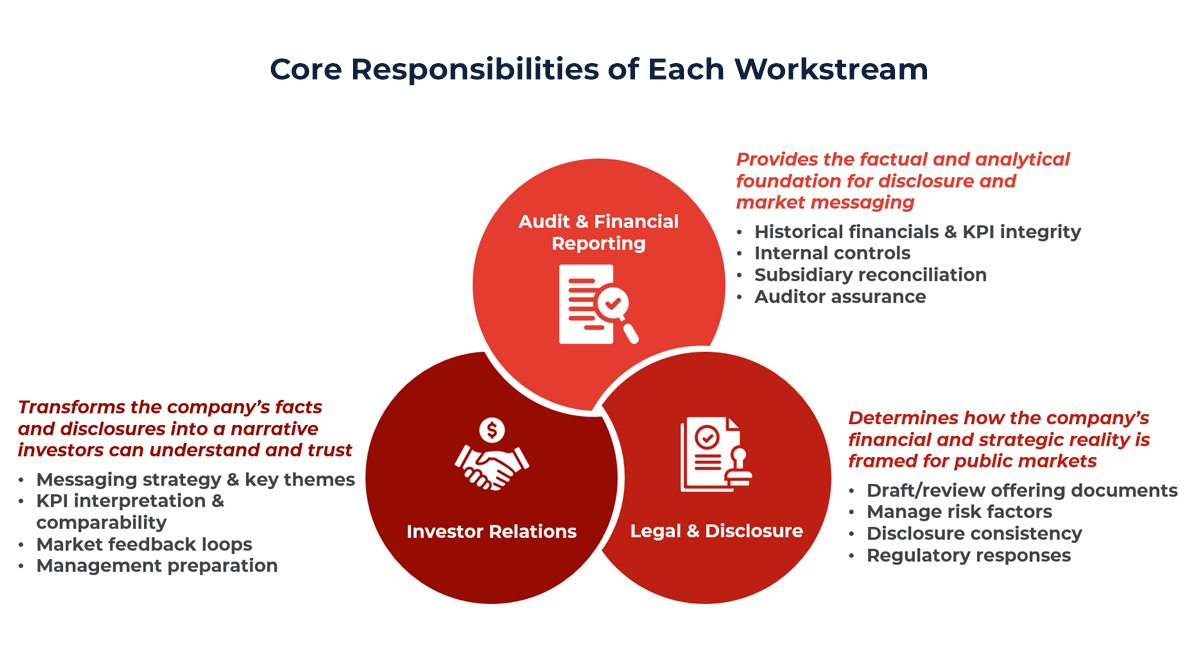
1. Audit and Financial Reporting
Audit anchors the numerical truth of the business, its performance, financial condition, and underlying drivers. These outputs ground every other aspect of execution, from regulatory filings to valuation narratives. When financials are clear, consistent, and stable, issuers can engage confidently with counsel and investors. When they are incomplete or late-changing, disclosure work stalls, messaging must be rewritten, and timelines invariably slip.
In most transactions, the pace at which audit progresses effectively dictates the speed of the entire process.
2. Legal and Disclosure
Legal ensures that disclosure is accurate, coherent, and defensible; translating the company’s financial footing into language that meets regulatory expectations and protects the issuer. It defines what can be said, how it must be qualified, and where additional context is required.
When legal is aligned early with audit outcomes and strategic messaging, issuers maintain a consistent, stable narrative across documents. When misaligned, teams face drafting churn, regulatory challenges, and credibility drag that can delay pricing.
3. Investor Relations
Investor relations is where the communications and story take shape, linking financial results, operating dynamics, and strategy to create a compelling, market-relevant narrative. Effective communication enables investors to interpret the numbers, compare performance to peers, and build conviction in the issuer’s future trajectory.
When investor messaging aligns with audit and disclosure, issuers move quickly and preserve valuation. When it drifts or evolves independently, market feedback becomes fragmented, execution risk increases, and investor confidence deteriorates.
The Playbook in Theory
Capital markets execution is a disciplined, well-sequenced process. Audit, legal, and investor relations advance in parallel under a unified governance structure, supported by clear decision rights and structured feedback loops. When followed, it enables issuers to maintain momentum, minimize rework, and present a coherent, well-substantiated narrative to the market.
Four principles form the foundation of this best-practice approach:
1. Early alignment on facts and narrative
Issuers begin by aligning core financial information, strategic priorities, and performance indicators before drafting begins. This creates a shared starting point that reduces downstream rework and establishes consistency across documents and messaging.
2. Parallel workstreams with coordinated checkpoints
Rather than operating linearly, audit, legal, and investor teams run at the same time; guided by common milestones. Structured checkpoints ensure that new information flows efficiently across teams and that decisions are incorporated before they become bottlenecks.
3. Progressive drafting with disciplined version control
Draft documents evolve continuously rather than in large, infrequent releases. Redlines are managed systematically, with clear ownership of comments and swift resolution of dependencies. This enables faster convergence toward a final narrative.
4. Clear governance and issue escalation
A single accountable owner oversees the timeline, prioritizes cross-stream decision, and resolves conflicts. Defined escalation paths ensure issues are surfaced early and addressed before they affect critical milestones.
With this approach, integration is intentional. The numbers, the disclosure language, and the investor story evolve together, reducing misalignment and compressing time-to-filing.
The Reality on the Ground
While the ideal approach provides structure, real-world execution is far less linear. Even experienced issuers encounter ambiguity, shifting information, and competing priorities that complicate coordination. Audit, legal and investor workstreams often move at different speeds, creating tension that must be effectively managed. Understanding these dynamics is essential to interpreting why timelines slip and why some issuers maintain momentum while others stall.
Several realities commonly emerge during live execution:
1. Audit sets the practical pace
Regardless of planning, the speed at which financials are validated frequently determines how quickly other workstreams can progress. Late adjustments to metrics, consolidations, or internal controls often cascade into disclosure changes and messaging revisions.
2. Disclosure evolves repeatedly
Even with early alignment, legal drafting rarely progresses in a straight line. Financial updates, operational developments, and regulatory feedback can trigger multiple rounds of edits. As a result, convergence toward final language may take longer than anticipated.
3. The narrative is not static
Investor messaging evolves as teams refine the company’s positioning, respond to competitive developments, or incorporate updated financials. This iterative process can be healthy, but when not tightly coordinated, it leads to mismatches between the numbers, the documents, and the story,
4. Interdependencies create friction
What appears independent on paper is tightly coupled in practice. A change in reporting structure may necessitate additional disclosure; new disclosure may require revised messaging; revised messaging may raise new investor questions that prompt deeper analysis. These loops are often underestimated.
5. Progress relies on timely judgement calls
Even with clear governance, decisions often involve trade-offs. Speed versus completeness; precision versus clarity; disclosure breadth versus narrative focus. The ability to make pragmatic choices quickly is more important than adhering rigidly to process.
In short, execution is rarely clean. While these realities introduce friction, they are not insurmountable. Issuers that maintain momentum do so by putting in place structures that allow teams to collaborate despite ambiguity and evolving information. The right operating mechanisms help ensure that changes in one workstream are recognized quickly, assessed thoughtfully, and reflected consistently across others. These mechanisms do not eliminate complexity; they make it manageable.
Building Blocks of Effective Workstream Alignment
Effective alignment does not emerge on its own. It is designed. The following six building blocks create an operating environment where audit, legal, and investor relations stay aligned as information evolves.
- Unified data foundations: A single source of truth for financials and KPIs, with clear definitions and reconciliation provides a consistent basis for disclosure and messaging. Shared reference materials help minimize rework downstream.
- Central coordination hub: A coordination function that tracks milestones, manages dependencies, and ensures changes in one stream are quickly communicated to others.
- Tight operating cadence: Short, predictable checkpoints enable teams to validate new information, surface constraints, and resolve issues early.
- Disciplined drafting routines: Progressive drafting and clean version control help documents evolve coherently, reducing duplication and accelerating legal convergence.
- Defined escalation pathways: Pre-agreed decision routes ensure that issues are resolved before they stall execution, rather than bouncing across functions without clear ownership.
- Timely leadership engagement: Targeted involvement from senior management at critical junctures helps align priorities, confirm trade-offs, and maintain momentum.
Put in place, these foundations help workstreams stay connected, but they are only part of the equation. Two issuers may have equally strong processes on paper, yet experience very different outcomes in practice. The difference is rarely about design; it is about application. What ultimately differentiates the most effective issuers is how they leverage these building blocks when execution becomes messy and trade-offs are unavoidable.
How Top Issuers Differentiate Themselves
It is in this context that top issuers distinguish themselves; not by having more sophisticated processes, but by using the same building blocks with greater discipline to maintain momentum and narrative coherence.
Three differentiating behaviors stand out:
1. They adjust only when impacts are demonstrably material
Top issuers use early alignment on KPIs, definitions, and narrative anchors to set practical “reference points”. They understand theses may evolve, but they aim to absorb change rather than constantly redistribute it.
In practice, this means:
- They adjust only when impacts are demonstrably material
- They communicate changes quickly and consistently
- They avoid re-opening questions that were already resolved
This prevents downstream churn in drafting, messaging and analysis. Weaker issuers tend to revisit decisions frequently, triggering rework across workstreams and eroding internal confidence.
2. They treat cadence as a mechanism to unblock; not just update
Top issuers use structured interaction to close issues, not simply to discuss them. They come prepared to decide, resolve, and move on using the operating rhythm to create forward motion.
Their forums focus on:
- Prioritizing the issues that genuinely matter
- Assigning clear next steps with deadlines
- Confirming cross-stream implications
- Escalating only when necessary
This prevents issues from lingering and compounding as timelines tighten. Less effective issuers often use cadence to report status, rather than to drive convergence leading to unresolved items building up late in the process.
3. They place uncertainty where it can be managed most effectively
Execution inevitably produces questions that span multiple workstreams. Rather than letting these float, top issuers assign each to the function best positioned to handle it. Whether the technical rationale belongs with audit; the framing sits with legal; or the contextual interpretation is better addressed through investor messaging.
They also apply judgement to distinguish between refinements that strengthen disclosure or understanding, versus changes that add complexity without improving clarity.
This intentional allocation keeps workstreams moving instead of debating ownership, a key difference from issuers who let unresolved questions circulate until they become bottlenecks.
In essence, top issuers differentiate themselves not by eliminating ambiguity but by using structure to make better, faster decisions when it matters most. Yet in practice, applying these disciplines consistently can be challenging; especially for organizations navigating a capital markets process for the first time or balancing execution alongside day-to-day operations. This is where experienced external support can reinforce alignment and help maintain momentum.
ARC Group’s Value Add
For many issuers, the difficulty is not recognizing what good execution should look like, but sustaining it under real market conditions. Information shifts quickly, multiple stakeholders need to be coordinated, and the time required to keep audit, legal, and investor streams aligned often exceeds internal bandwidth. ARC Group helps close this gap by reinforcing the structure and judgement needed to keep workstreams advancing together.
A key area of support lies in translating change into coordinated action. As financials are refined or disclosure language shifts, we help ensure implications are clearly understood across workstreams and reflected consistently in documents and messaging. This reduces fragmentation and limits the rework that often arises when teams respond in isolation.
We also help issuers maintain momentum by enabling prompt decision making. Capital markets execution involves a series of trade-offs, how to frame KPIs; how much details to include; how to position uncertainty. ARC Group brings practical capital markets experience to help issuers frame decisions objectively, assess downstream impacts, and clarify ownership so issues do not linger unresolved.
Alongside this, we bring market-oriented view to narrative development and sequencing. Whether refining which indicators investors care about most or determining how sensitive topics should be positioned, we help issuers strike the right balance between clarity, transparency, and investor relevance. This perspective helps issuers differentiate between what belongs in disclosure, what is more appropriate for investor materials, and how to sequence messages to build understanding and credibility.
We integrate alongside management, counsel, and auditors; helping maintain structure, reduce rework and preserve narrative coherence. Our mandate is simple: precision, pace, and alignment.
Author:
Sean Lio
Capital Markets